
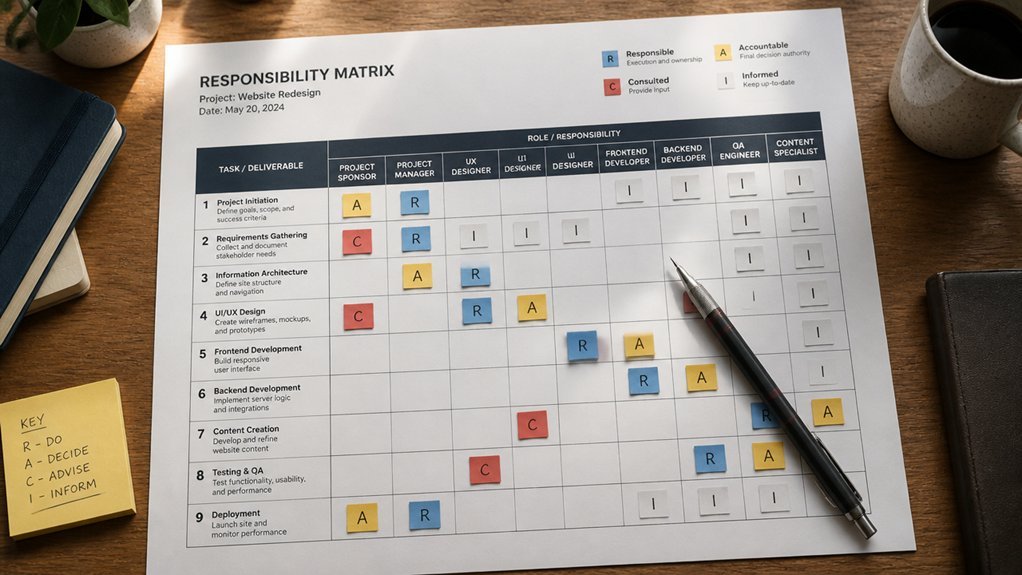
A construction responsibility matrix serves as the backbone of project coordination. It maps out exactly who handles what by assigning clear roles to every stakeholder involved. The familiar RACI framework—Responsible, Accountable, Consulted, Informed—keeps things organized without overcomplicating the process.
Project managers, architects, subcontractors, and inspectors all need defined duties to function as a team. Someone must own permits. Another party drives scheduling. Inspections and safety protocols demand their own designated leads. When these assignments live in a single shared document, everyone knows where to look for answers.
Gaps in accountability create real problems on job sites. Tasks slip through cracks. Deadlines get missed. Disputes arise over who was supposed to act. The matrix prevents this by making expectations visible to all parties from day one.
Building an effective matrix takes upfront effort. Stakeholders need input during creation, not after. Roles must reflect actual authority, not just ideal workflows. Revisit it as the project evolves, and it becomes a living tool rather than shelfware.
The Four RACI Roles Explained

A responsibility matrix relies on four distinct roles, each carrying specific duties on construction projects.
The Responsible party executes the work, such as electricians installing wiring systems. The Accountable person holds final authority and approval power, typically the project manager.
The Consulted individuals provide input before decisions occur, including safety officers and engineers. The Informed parties receive updates after actions conclude, such as clients and stakeholders.
Each role guarantees clarity, prevents task overlap, and identifies gaps in workflow.
Construction teams assign these roles to specific personnel or departments, clarifying expectations and deliverables throughout project phases.
Map Out Your Project Phases and Key Tasks
Creating an effective responsibility matrix begins by identifying the distinct phases of a construction project and listing the critical tasks within each phase. Typical phases include preconstruction, foundation work, framing, mechanical systems, finishing, and closeout.
Within preconstruction, tasks involve permits, site surveys, and budget approval. Foundation phases require excavation, concrete pouring, and inspection.
Framing includes structural assembly and safety protocols. Mechanical phases encompass electrical, plumbing, and HVAC installation.
Finishing involves drywall, painting, and flooring. Closeout includes final inspections and documentation.
Breaking projects into phases and identifying specific tasks allows teams to assign clear responsibilities, preventing overlap and confusion throughout construction.
Identify All Stakeholders and Team Members
Who participates in a construction project beyond the general contractor and workers? Project managers, architects, engineers, subcontractors, inspectors, and safety coordinators all play essential roles.
Material suppliers, equipment vendors, and site foremen contribute to daily operations. Clients, permit officials, and neighboring property owners hold significant influence.
Insurance agents and legal representatives manage liability and compliance issues. Each person brings specific responsibilities and decision-making authority to the project.
Understanding these participants prevents confusion about who handles what tasks. Creating a thorough list guarantees all contributors receive appropriate assignments in the responsibility matrix.
Build Your Responsibility Matrix
Organizing the stakeholder list into a structured chart creates clarity about roles, tasks, and decision-making authority on the construction project. The matrix typically uses a grid format, with stakeholders listed vertically and project activities listed horizontally. Each cell indicates the level of involvement, such as responsible, accountable, consulted, or informed.
For example, the project manager might be accountable for schedule adherence, while subcontractors are responsible for specific trade work.
Safety officers receive consultation on hazardous tasks. This visual tool prevents confusion about who performs what work and guarantees everyone understands their obligations throughout the construction process.
Implement Your Matrix Across Your Team and Tools
Distributing the responsibility matrix throughout the construction project requires integration into existing team workflows and project management systems. Teams should upload the matrix to shared platforms like Asana, Monday.com, or project management software already in use.
Project managers assign specific roles and tasks to team members, ensuring everyone understands their responsibilities.
Regular training sessions help staff understand matrix components, clarify expectations, and reduce confusion. Digital access allows real-time updates when roles change or projects shift.
Weekly team meetings reinforce accountability, address conflicts, and adjust assignments.
Documentation in contract terms and job descriptions creates legal clarity, supporting consistent implementation across all construction phases and departments.
Use Your Responsibility Matrix to Prevent Common Problems
A well-implemented responsibility matrix serves as a preventive tool, addressing problems before they arise on construction sites. By clarifying who owns specific tasks, the matrix eliminates confusion about decision-making authority, reducing delays and rework.
Teams avoid duplicated efforts, missed deadlines, and accountability gaps when roles are clearly defined. The matrix prevents scope creep by establishing boundaries for each stakeholder’s involvement. Miscommunication between subcontractors and general contractors decreases markedly. Change orders get processed more efficiently. Safety responsibilities remain explicit, reducing incident risks.
Regular matrix reviews catch emerging issues early, keeping projects aligned with timelines and budgets.
Update Your Matrix as the Project Evolves
Construction projects change throughout their lifecycles, making static responsibility matrices insufficient for long-term success. As project phases shift from planning to execution to closeout, roles and accountabilities require adjustment. Team members may shift on or off the project, necessitating matrix updates.
When scope changes occur, responsibilities for new tasks must be clearly assigned. Regular review schedules, typically monthly or quarterly, help identify needed modifications. Outdated matrices create confusion, missed deadlines, and accountability gaps.
Project managers should document changes, communicate updates to all stakeholders, and maintain current versions accessible to the entire team. This ongoing refinement guarantees clarity and operational effectiveness throughout the project duration.
Frequently Asked Questions
How Do You Handle Responsibility Conflicts When Multiple Team Members Have Overlapping Duties?
One resolves overlapping duties by clarifying role boundaries through documented responsibility matrices. Team members should establish communication protocols, define decision-making authority, and escalate conflicts to project management for mediation and clarification.
What’s the Best Software or Template to Use for Creating a Construction Responsibility Matrix?
Popular options include Microsoft Excel, which could literally organize a million tasks simultaneously, Smartsheet, Asana, and Monday.com. Templates from the Project Management Institute or construction-specific platforms like Bridgit offer pre-built frameworks that streamline the matrix creation process efficiently.
How Often Should Responsibility Matrices Be Reviewed During Active Construction Projects?
Responsibility matrices should be reviewed quarterly during active construction projects, or whenever significant scope changes occur. Monthly reviews are recommended for complex projects with multiple stakeholders to guarantee clarity and prevent accountability gaps throughout execution phases.
Can a Single Person Hold Multiple RACI Roles for Different Project Tasks?
Yes, one individual can hold multiple RACI roles across different tasks. While this practice risks role confusion and workload imbalance, it proves practical in smaller construction teams where specialized expertise concentrates responsibility across fewer personnel strategically.
How Do You Communicate Matrix Changes to Team Members Without Causing Confusion?
Organizations should distribute updated matrices through formal channels, schedule dedicated briefings, and provide written documentation. Clear explanations of role changes, effective dates, and individual responsibilities help minimize confusion among construction team members during shifts.
Conclusion
A well-constructed responsibility matrix creates a clear blueprint of project roles, eliminating confusion and overlaps. Team members see their assignments, architects understand their scope, and inspectors know their checkpoints. This organized framework, regularly updated, prevents gaps where tasks fall through cracks. When stakeholders understand who decides, executes, and reviews each activity, projects move forward with precision and accountability intact.